

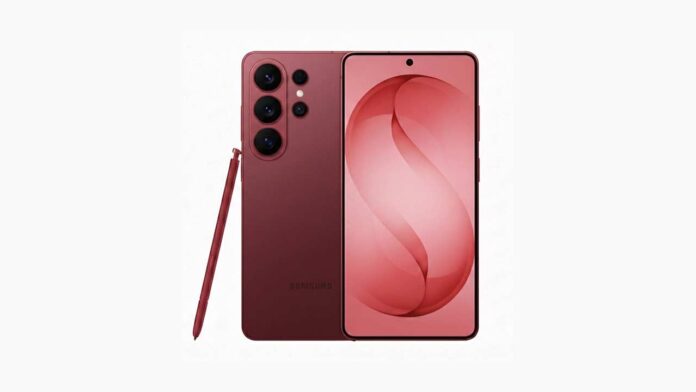
Samsung may be about to make a silent, but significant change in our phone unlocking habits. The company is now ready to revive face unlock, as it has been years since it highlighted fingerprint scanners. It is not the low-cost camera version that many users disregarded a few years back. The concept under consideration is known as Polar ID, and if it makes it to the Galaxy S27 Ultra, it could transform what Android phones are capable of in face authentication.
Speed or style is not what is interesting about this. It is the vow that gives good security without altering the appearance of the showcase. There is no notch, no floating cutout and no apparent compromise of screen space.
Table of Contents
A New Direction of Samsung Face Unlock
Samsung had tried face unlock on previous Galaxy phones, but it did not work fully. It was based on ordinary cameras; therefore, it was easy to deceive and difficult to believe. As time went by, Samsung redirected its efforts to include display fingerprint scanners, in particular, ultrasonic scanners. They have safe but not always convenient scanners. A fast unlock can be a little tricky when the hands are wet or when dust or gloves come into contact with a button. Polar ID comes into the picture at that. It will aim to provide the convenience of face unlock with a level of security more akin to Face ID for Apple users.
What Is Polar ID Technology?
Polar ID is not a camera trick. It operates upon the reflection of light on actual human skin. The system not only scans a face but also looks for the presence of living tissue.
Here is the simple idea. When light hits your face, it does not react the same way it does on a photo, a mask, or a screen. The tiny differences are examined by Polar ID. This is to ensure that the phone is in the hands of a real person.
This feature makes it more difficult to defraud than simple face unlock systems. It also does not require a large amount of hardware, unlike other secure face recognition systems.
Samsung and Metalenz Partnership Explanation
Samsung is also reported to be collaborating with Metalenz, a company specializing in compact optical technology. They have been working collaboratively on Polar ID, which is deemed a hardware, not software, shortcut.
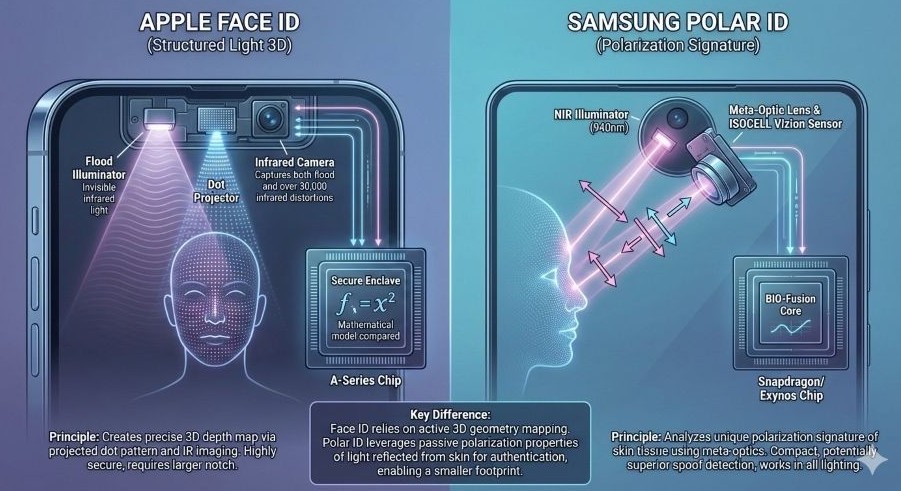
The system can consist of a floodlight and the Samsung ISOCELL Vizion 931 sensor. To put it simply, it means the phone can scan facial data even in complete darkness. No brightness is visible, and no additional light is required.
One key benefit is size. The Face One key benefit is size. Apple’s Face ID requires a lot of space, which is why it still has a notch or island. Polar ID is compact, as it can be integrated into Samsung’s existing punch hole.ID and Apple Face ID
Apple Face ID projects thousands of infrared dots to develop a three-dimensional map of your face. It is safe, yet the equipment occupies space.
Polar ID works differently. Polar ID works differently. It focuses on the behavior of light on the skin rather than on creating a complete 3D model. This makes the system less plump and can be concealed behind the display space, which is already occupied by the front camera. Their approach to that goal is the difference. Apple is dependent on depth mapping. Polar ID is based on the light response of the biological response.
The Importance of all this to Galaxy S27 Ultra
When Polar ID comes to the Galaxy S27 Ultra, it may offer an additional secure way to unlock the phone. It seems important, since there is no ideal biometric method that can be used in all circumstances.
Fingerprint scanners cannot work on wet or dirty fingers. Face unlock via the camera does not work well in a dark environment and is not very secure. Polar ID lies between the two extremes. It is promising to have quick access without any apparent weak points.
It might also contribute to everyday life. It is natural to pick up your phone and unlock it without having to touch the screen. When properly executed, it is time-saving and does not compromise safety.
Samsung expects to release the Galaxy S26 series in late February 2026. The Galaxy S27 line should follow about 12 months later, likely in early 2027.
It is to say that Polar ID is still in its evolutionary stages. No one is sure of anything, and strategies are subject to change. Samsung has already tried concepts that never made it to the shelves. It is regarded as a high-potential, not a guarantee.
Conclusion
Samsung appears willing to reconsider face unlock, and Polar ID may be the device that makes it viable. The company can provide a secure system by focusing on real-skin detection and miniature hardware, without compromising its clean display design.
If the Galaxy S27 Ultra is released with Polar ID, users may have a reliable alternative to fingerprints without compromising space or screen security until then. It is not a stupid idea, the technology is not impractical, and the timing is not bad. The question is now whether Samsung delivers the goods.