

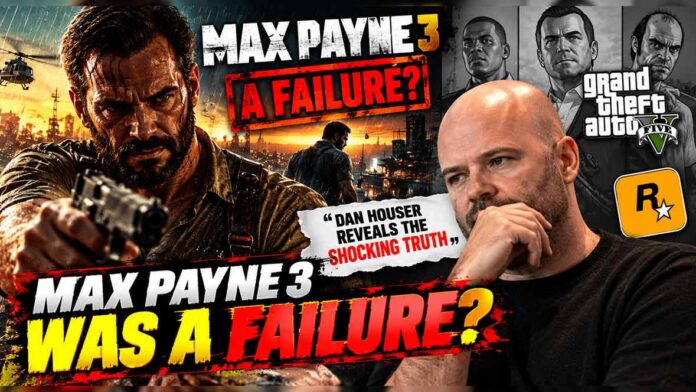
Rockstar Games is one of the world’s most successful video game development companies, with games like Grand Theft Auto V and Red Dead Redemption among the best-selling in history. Yet even the company’s most prominent writers may sometimes fail to understand what a certain audience wants and expects from their product. Dan Houser, one of Rockstar’s co-founders and a scriptwriter for many of the company’s games, has apparently concluded that he did a wrong thing by creating Max Payne 3.
In his interview for IGN30 Icons, Houser reflected on his experience making the game in 2012 and identified where he went wrong. The writer spoke of liking how it was turned into a “cinematic experience,” the “very tight script,” and “visual design.” Yet not many did, and even Houser himself felt his approach to the characters was faulty.
Worse still, he even called his contribution to the game a failure and accepted responsibility for the decisions he made as writer and director. There is much to say about Max Payne 3 and its impact on the audience. Still, the main point anyone should take from this episode is that reimagining a renowned series isn’t always easy, and changing a script can prove an even harder. It is unlikely this installment should be seen as a failure, since both critics and players mostly responded well to the changes. Yet it’s clear the people behind the game didn’t succeed in creating a work that accurately represented the series’ spirit.
Table of Contents
Dan Houser Admits He Got Max Payne 3 Wrong
When Rockstar took over the series from Remedy Entertainment, Houser wanted to give Max Payne a more cinematic storytelling approach. Rather than relying on an open world, Max Payne 3 used a linear structure that let the developers control the pace of the action and the story.
Houser enjoyed the result. He saw the game as digital noir, with carefully directed scenes, seamless transitions, and words appearing on screen as part of its visual style.
The problem was that his vision did not connect with enough of the audience he wanted to reach.
Reflecting on the outcome, Houser said, “I failed. My bit was not a success.” He also acknowledged that many players missed Sam Lake’s writing, the creative mind behind the first two Max Payne games.
That admission matters because Houser wasn’t dismissing the game’s technical quality. He believed the finished product was well made. Still, he felt his decisions kept it from meeting the expectations attached to the franchise.
There is a useful distinction here. A game can deliver polished combat, strong performances, and impressive visuals while still missing part of the identity that attracted its original audience.
Houser’s comments suggest that he now sees Max Payne 3 through that lens.
Was Max Payne 3 Really a Critical Failure?
Despite Houser’s harsh assessment, available review scores don’t support the idea that Max Payne 3 was a critical failure.
According to Metacritic, the game received an 86 Metascore based on 80 critic reviews for the Xbox 360 version. It also holds an 8.0 user score on the same platform overview. The site classifies its critical reception as “Generally Favorable.”
Those numbers tell a different story than the word “failure.”
Critics praised the shooting mechanics, action sequences, presentation, and intense pace. The game also kept familiar features like Bullet Time and the Shootdodge move, which let Max slow time and launch himself into combat.
The strong reception does not mean every player enjoyed the changes. Review scores measure broad critical opinion, while Houser was reflecting on whether his creative direction delivered the experience fans wanted from this particular series.
The distinction is important. Max Payne 3 can be a well-reviewed shooter and still disappoint some longtime followers.
It is also worth being careful with claims about sales. Houser said the game wasn’t as successful as it should have been, but that statement alone doesn’t establish an exact sales shortfall. Without a verified sales figure or a clear financial target, presenting a specific commercial failure as settled fact would be misleading.
In other words, the strongest evidence points to Houser’s disappointment with his creative choices, rather than proof that the game failed in every sense.
Why Fans Missed Sam Lake’s Writing
To understand the reaction to Max Payne 3, it helps to look at the series’ earlier identity.
Remedy Entertainment developed the original Max Payne and its sequel, Max Payne 2: The Fall of Max Payne. Sam Lake played a central writing role in those games, helping define Max as a troubled detective whose thoughts, memories, and bitter humor shaped the experience.
The early games used noir storytelling, graphic-novel-style scenes, and a world filled with loss, paranoia, and bleak humor. Max’s inner monologue was part of the appeal. Players did not simply watch him fight criminals; they experienced the world through his damaged outlook.
Rockstar’s third game took a different approach.
The change was understandable. The story needed to move Max forward, and repeating the same formula would have risked making the character feel stuck. Rockstar also had its own strengths in cinematic presentation and detailed action.
However, a familiar character does not automatically produce a familiar experience.
Many fans associated Max Payne with the writing style of the first two games. By changing that voice and presentation, Rockstar changed how the character felt, even though it retained his history, personality, and struggles. Houser’s later comments show that he understands this difference.
He specifically praised Lake’s talent and acknowledged that players missed his writing.
That is a more useful explanation than saying fans refused to accept change. Players can welcome new ideas while still expecting a sequel to preserve the qualities that made the original work.
How Rockstar Changed Max Payne’s Setting and Tone
Another major change was the location.
The first two games drew heavily on New York’s dark streets and winter atmosphere. Max Payne 3 moved the action to São Paulo, Brazil, where Max works in private security for a wealthy family.
The new setting gave Rockstar different environments to explore, from crowded streets to luxury buildings. It also let the studio tell the story of a man trying to escape his past in an unfamiliar place. Rockstar’s official game page describes Max’s struggle to leave his troubled history behind, only for events to spiral out of control.
The brighter Brazilian environment also contrasted with the earlier games’ cold, rain-soaked look. That change was not automatically a mistake. Max’s circumstances had changed, and the new location gave his story a different backdrop.
The larger issue was how those changes worked together.
Rockstar put a familiar character in a new setting and gave his story a tighter, more cinematic structure. For players who enjoyed the new approach, that combination helped the game stand apart. For others, it made the sequel feel less like the Max Payne they remembered.
No single design choice explains every negative reaction. The setting, dialogue, presentation, and pacing all contributed to the experience. Treating the controversy as a simple argument over Brazil versus New York would miss the larger point.
Max Payne 3’s Gunplay Was One of Its Biggest Strengths
Storytelling may have been Houser’s main concern, but the game’s combat earned widespread praise.
Max Payne 3 used weighty shooting mechanics, detailed character movement, and slow-motion gunfights to make its action feel direct and intense. Bullet Time remained central to combat, allowing players to slow the action and react to threats.
The game also used carefully staged sequences to connect its action with its story. Rather than giving players a large world to explore, Rockstar guided them through a series of missions with specific objectives and set pieces.
That structure helped the developers control the pace. It also gave players less freedom to explore or approach the campaign differently.
Metacritic’s archived reviews show that the core experience worked well for many critics. The Xbox 360 version received an 86 Metascore, while the PC version earned an 87. Both scores fall within the site’s generally favorable category.
The reviews help explain why calling the entire game a failure is too broad. Its shooting mechanics and presentation received strong recognition, even as its direction differed from what some fans expected.
A strong action game does not have to satisfy every fan of an established franchise. Yet a sequel carries expectations a new intellectual property doesn’t, and Rockstar had to balance those expectations with its own creative approach.
Max Payne Remakes Could Give the Series Another Chance
The Max Payne story is not over. Remedy Entertainment is developing remakes of the original Max Payne and Max Payne 2: The Fall of Max Payne under an agreement with Rockstar Games, which will publish the project.
Remedy’s official project page lists the remake as a single title for PC, PlayStation 5, and Xbox Series X|S. The page does not list a release year, so there is no confirmed launch date to report.
The project gives the franchise a chance to introduce the earlier stories to a new audience while revisiting the games that established Max’s identity.
It is too early to say how closely the remakes will follow the originals or what changes Remedy might make. Still, Remedy’s involvement matters because the studio created the first two games, and the writing of those titles remains central to the debate around Max Payne 3.
The remakes also give players an chance to experience the series in sequence. Newcomers could start with the original story before seeing how Max’s life changed in later entries.
However, the remakes should not be treated as a direct response to Houser’s comments. Remedy and Rockstar have announced the project, but neither has confirmed that his recent assessment will change the remakes’ direction.
What About GTA 6?
Rockstar has another major release approaching. According to the official Grand Theft Auto VI website, GTA 6 is scheduled to launch on November 19, 2026, for PlayStation 5 and Xbox Series X|S.
That release is separate from the Max Payne remakes, and the announcement doesn’t link the two projects’ schedules.
Houser’s comments also concern his work on Max Payne 3, not his current role in GTA 6‘s development. His retrospective offers insight into an earlier creative decision. Still, it shouldn’t be read as a statement about Rockstar’s current plans.
For readers interested in both franchises, the more direct connection is Rockstar’s storytelling approach. Its games often rely on strong characters and tightly controlled scenes, even when they offer very different gameplay styles.
Max Payne 3 showed how well that approach could work for action. It also showed the limits of applying a new style to a series with an established voice.
Final Verdict: Max Payne 3 Was Not a Simple Failure
Dan Houser’s admission is worth taking seriously, but the headline needs context.
He believes his creative choices failed to capture what many Max Payne fans wanted. He also accepts responsibility for his writing and the decisions he helped make. That is a candid assessment from someone who played a major part in shaping the game.
However, the critical record paints a more balanced picture. Max Payne 3 earned strong reviews for its shooting, cinematic presentation, and action. Its reception wasn’t a universal rejection, and Houser’s personal judgment doesn’t erase the qualities players still appreciate.
The real issue was the gap between what Rockstar wanted Max Payne 3 to become and what some fans expected from the series. Rockstar made a polished, tightly directed shooter, but its new tone and narrative style did not work for everyone.
That distinction matters more than the word failure on its own.
The upcoming Max Payne remakes now give Remedy and Rockstar another chance to revisit the original stories. Until more details emerge, we cannot know whether they will address the concerns that followed the third game.
For now, Max Payne 3 remains a well-reviewed action game whose lead writer believes he missed the mark. Sometimes, even a game that gets many things right can leave its own creators wondering what they should have done differently.