

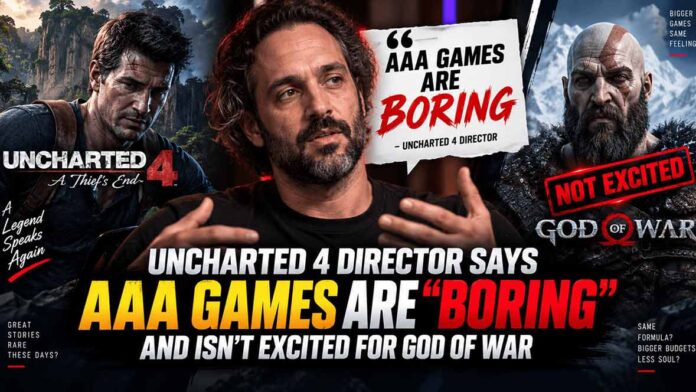
Bruce Straley, the director behind Uncharted 4 and The Last of Us, has offered pointed criticism of the modern AAA game industry, describing many big-budget releases as “boring.” He cited God of War: Laufey to explain why the craftsmanship of contemporary blockbusters doesn’t always translate into fresh gameplay.
In Straley’s view, today’s AAA productions can pour enormous resources into visual fidelity and technical polish while still struggling to introduce genuinely inventive ideas. The upcoming God of War: Laufey appears to fit that concern for him. He recognizes the extraordinary labor behind such a project, yet questions whether players get anything sufficiently adventurous once they pick up the controller.
Speaking with Edge Magazine’s Alex Spencer, Straley praised Santa Monica Studio’s craftsmanship and admitted that the upcoming game’s visual detail left him stunned. His reaction carries some weight because he has worked on similarly demanding productions, including the first The Last of Us alongside Neil Druckmann.

“God of War Laufey, I look at that game, and every pixel is mind-blowing. The amount of work and skill that’s gone into every single frame… I’ve made those kinds of games, and I’m still blown away,” Straley said.
Yet admiration for the production itself does not mean he is eager to play it. His criticism is aimed less at Santa Monica Studio and more at the broader direction of AAA game design.
"But when I actually look at what you're doing in the game? I'm not excited. And that's nothing against the God of War team. Just, across the board in triple-A, it feels like there's no opportunity to inject fresh, innovative ideas."
Straley’s argument centers on a familiar tension in modern blockbuster development. AAA studios spend years building enormous games, with large teams working on animation, cinematics, environments, combat systems, sound, performance, and visual effects. The result can look spectacular while still following design formulas players have seen many times before.
That distinction is important in Straley’s comments. He is not dismissing the people making these games or the immense craftsmanship involved. In fact, he openly acknowledges how difficult it is to produce a game at this scale. His frustration lies with the limited room for experimentation within the AAA model.
God of War Laufey could still take a different route. The game may retain the familiar foundations associated with the series while introducing ideas that have not yet been revealed. Until players see the finished product and spend time with its systems, it is hard to tell whether Straley’s concern applies to this particular release.
Straley has since moved away from Naughty Dog and is working on Coven of the Chicken Foot through his own studio, Wildflower. He left Naughty Dog in 2017, several years before The Last of Us Part 2 arrived.
That departure also means Straley isn’t involved in Naughty Dog’s next major project, Intergalactic: The Heretic Prophet. The studio announced the title as its next AAA franchise, giving it a new setting and cast separate from its previous major series.
For Straley, the criticism of AAA development comes as much from experience as from observation. He has spent years working on large-scale productions, so he knows firsthand how much labor can disappear behind a single polished frame. His comments raise a straightforward question: when games become bigger, more expensive, and more technically elaborate, does that leave enough room for unusual ideas?
God of War Laufey will eventually provide a practical answer to at least part of that question. For now, Straley’s remarks have opened a wider discussion about whether modern AAA games need more experimentation alongside their increasingly polished presentation.