

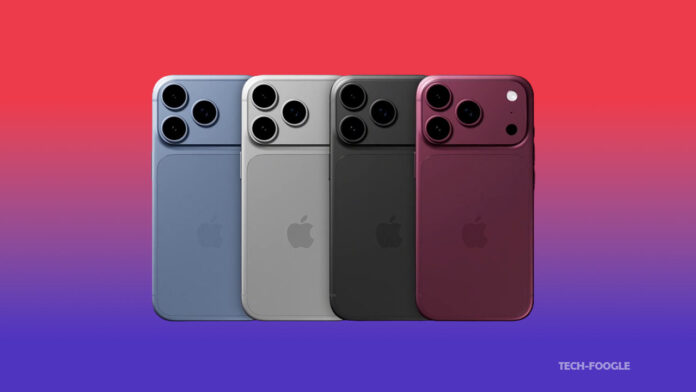
Apple’s M6 has entered the spotlight, offering an intriguing preview of the silicon direction Apple appears to be taking next. The processor belongs to Apple’s Mac lineup, but several design elements offer useful clues about the forthcoming A20 Pro.
The A20 Pro will serve a different class of device. A smartphone chip faces tighter thermal limits, stricter power budgets, and a much smaller physical footprint than a desktop processor. Even so, Apple’s underlying silicon strategy often travels between product families.
The biggest clue is the move toward TSMC’s 2nm manufacturing process.
If Apple’s next-generation iPhone silicon follows the same trajectory, the A20 Pro should inherit some of the technological gains associated with the M6. That points toward stronger computational throughput, tighter power management, and more sophisticated AI processing inside the iPhone 18 Pro and iPhone Ultra.
Table of Contents
Apple A20 Pro Will Carry the 2nm Advantage
Apple’s recent M-series processors have relied on increasingly refined 3nm manufacturing technology. The M6 marks a significant shift by moving to a 2nm process.
That transition matters because a smaller process node gives chip designers more room to improve transistor density, efficiency, and performance. The exact gains inside a smartphone depend on Apple’s final architecture. However, the underlying manufacturing technology still sets the stage for substantial silicon refinement.
The A20 Pro is expected to follow the same 2nm path.
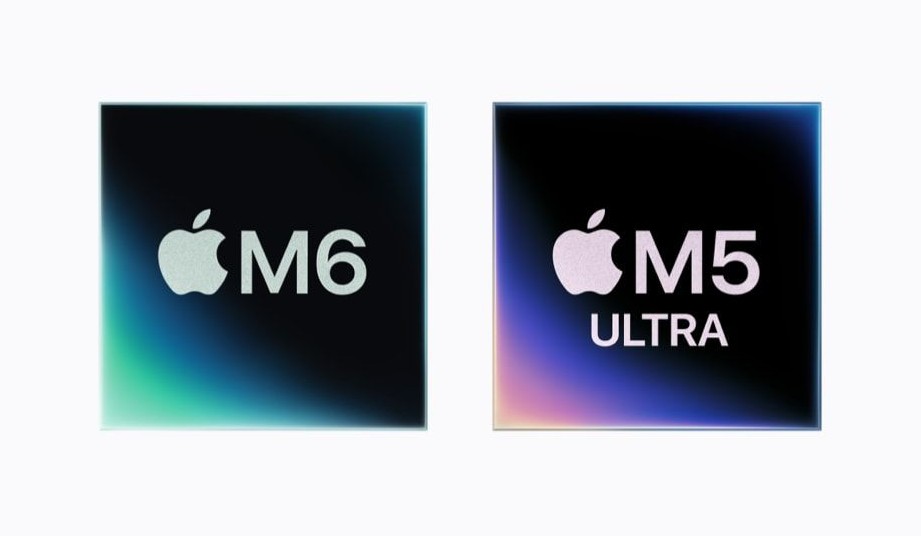
Apple will tailor the smartphone variant around the demands of the iPhone rather than transplanting the M6 architecture wholesale. A phone requires a different balance between sustained performance, thermal control, battery endurance, and compact packaging.
Still, the technological relationship between Apple’s mobile and desktop chips offers a useful precedent.
The A19 Pro and M5 already demonstrated how developments across Apple’s silicon families could share broader engineering principles. The A20 Pro therefore looks less like an isolated upgrade and more like another step in Apple’s wider processor roadmap.
For iPhone 18 Pro owners, the practical difference should show up in several areas.
Everyday interaction should feel more immediate. App launches, demanding games, camera processing, multitasking, and other processor-heavy workloads should all benefit from stronger silicon. The bigger question isn’t whether the A20 Pro will get faster. The more interesting question is how much performance Apple delivers without a corresponding penalty to battery life.
That balance has become increasingly important as smartphone workloads grow more sophisticated.
M6 Offers a Glimpse at Apple’s AI Ambitions
The M6 also provides an interesting clue about Apple’s growing emphasis on artificial intelligence.
According to Apple’s newsroom information, the M6 introduces a dual 16-core Neural Engine designed to deliver up to twice the peak AI compute performance of its predecessors.
The architecture also includes a new 12-core CPU arranged in a 2+4+6 configuration. Apple says the M6 delivers up to 1.2x faster multithreaded performance than the M5.
Those figures belong to the M6, not the A20 Pro, so they should not be treated as direct predictions for Apple’s next iPhone processor. The more useful takeaway involves the direction of Apple’s silicon development.
Apple continues to dedicate substantial silicon resources to machine-learning workloads.
That trend matters for the A20 Pro because future iPhones are expected to perform more AI processing locally. On-device processing reduces reliance on remote servers and gives applications access to dedicated computational resources without sending every task elsewhere.
A more capable Neural Engine would therefore have implications beyond benchmark charts. Photo processing, voice features, generative AI functions, image recognition, application intelligence, and other machine-learning workloads could all benefit from additional local compute.
WMCM Could Give the A20 Pro More Breathing Room
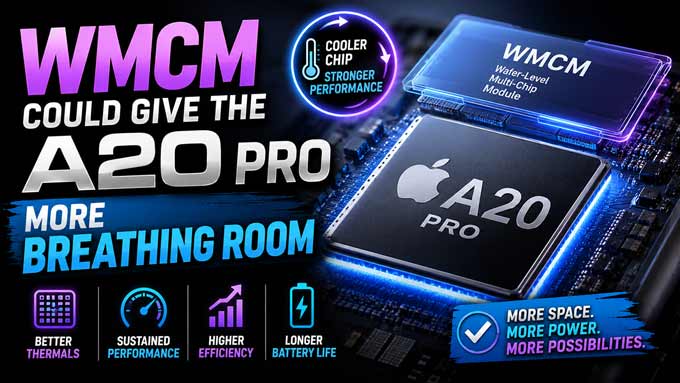
The manufacturing node is only one piece of the A20 Pro puzzle.
Reports have also pointed toward WMCM, or Wafer-Level Multi-Chip Module technology, for Apple’s next-generation smartphone silicon. Such packaging technology would give Apple another way to increase computational capability within a smartphone’s physical constraints.
Chip packaging has become an increasingly important part of processor design. Shrinking transistors alone does not solve every problem. Designers also need to consider how different silicon components communicate, how much space the package occupies, and how efficiently the system handles heat.
WMCM could help Apple pack more capability into a compact package while keeping the internal architecture organized around the demands of a smartphone.
Thermal management will remain equally important.
The A20 Pro is expected to incorporate HPB, or Heat Path Block, technology as part of Apple’s effort to control heat during demanding workloads. Gaming, video rendering, computational photography, and sustained AI workloads all generate considerable thermal output.
A faster processor loses some of its appeal if the device quickly reaches uncomfortable temperatures or throttles performance. Apple’s challenge, then, is maintaining high output over longer periods while keeping power consumption and heat within sensible limits.
What This Could Mean for the iPhone 18 Pro
The iPhone 18 Pro is expected to get the A20 Pro. At the same time, Apple’s rumored iPhone Ultra could also sit in the same hardware generation.
If Apple’s silicon roadmap holds, the combination of 2nm manufacturing, advanced packaging, improved thermal handling, and stronger AI hardware would represent a substantial internal redesign.
The biggest gains might not appear as one dramatic feature.
Instead, users could notice a collection of smaller improvements. Apps could respond faster. Intensive games could maintain higher performance for longer. Computational photography could finish processing more quickly. Video workflows could become less cumbersome. AI features could perform more processing directly on the phone.
Battery efficiency could prove equally significant.
A processor that delivers more work per watt gives Apple additional room to improve performance without endlessly increasing battery capacity. For a compact smartphone, every watt matters.
The A20 Pro therefore represents more than another processor-number upgrade. Its importance lies in the engineering decisions surrounding performance, efficiency, packaging, and heat.
Apple Faces a New 2nm Processor Race
Apple will not have the 2nm arena to itself.
Qualcomm and MediaTek are also expected to bring 2nm smartphone processors into the market. Their competing designs should create an interesting contest among the major mobile silicon manufacturers.
Raw benchmark scores will attract attention, but sustained performance, efficiency, modem integration, thermal behavior, AI processing, and real-world battery endurance will provide a more useful measure of success.
Apple’s M6 gives us an early look at the company’s broader silicon ambitions. The A20 Pro will not mirror the M6 piece for piece, yet the connection between the two chips offers plenty of clues.
The move to 2nm stands out as the clearest signal.
If Apple pairs the smaller process with advanced packaging, stronger AI hardware, and improved thermal engineering, the A20 Pro could become one of the most significant internal upgrades in the iPhone 18 Pro generation.
Apple is expected to introduce the iPhone 18 Pro, iPhone Ultra, two AirPods 5s models, and Apple Watch Series 12 during its September 2026 launch event.
The next chapter of the smartphone processor race is therefore shaping up around a smaller manufacturing node, denser silicon, smarter packaging, and relentless pressure to squeeze more performance from every watt.
The M6 has started the conversation. The A20 Pro will show how far Apple intends to take it.