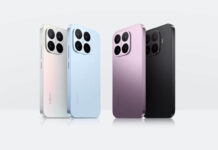

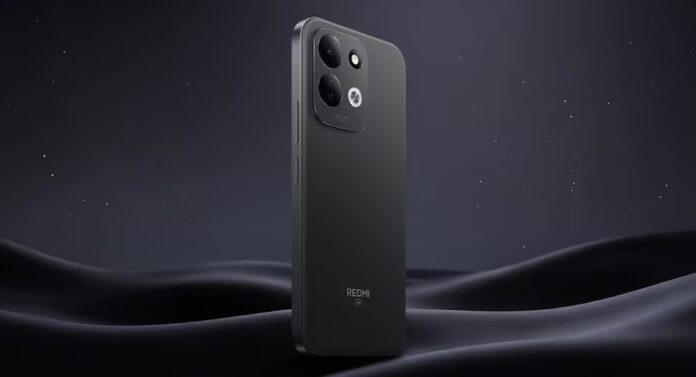
Redmi has quietly launched a new smartphone series in China, and the Redmi M100 is the first phone under the new M branding. The handset focuses less on flashy camera hardware and more on battery life, a large display, simple software features, and everyday usability.
The headline feature is easy to spot. The Redmi M100 packs a huge 7,900mAh battery with support for 45W wired charging and 22.5W reverse wired charging. Under the hood, Qualcomm’s Snapdragon 4 Gen 5 handles performance, while a 6.9-inch 120Hz LCD sits on the front.
Redmi also adds a senior care mode with larger icons, larger fonts, louder audio options, and unwanted-call blocking. So, while the M100 doesn’t chase flagship-style camera numbers, Redmi built a phone around a more practical idea.
Table of Contents
Redmi M100 Specifications at a Glance
The Redmi M100 brings a 6.9-inch LCD with a 1,600 × 720-pixel resolution and up to a 120Hz refresh rate. The panel also supports up to 240Hz touch sampling, while Xiaomi lists eye-protection features and Corning Gorilla Glass protection.
The phone uses the Snapdragon 4 Gen 5 mobile platform, built on a 4nm process with an octa-core CPU. Redmi pairs the chip with up to 8GB of LPDDR4X RAM and up to 256GB of UFS 2.2 storage.
The M100 also supports 5G connectivity. Other connectivity features include Wi-Fi 5, Bluetooth 5.1, NFC, GPS, and USB Type-C. A side-mounted fingerprint reader and a 3.5mm headphone jack also make the hardware fairly familiar and practical.
Redmi M100 Gets a Huge 7,900mAh Battery
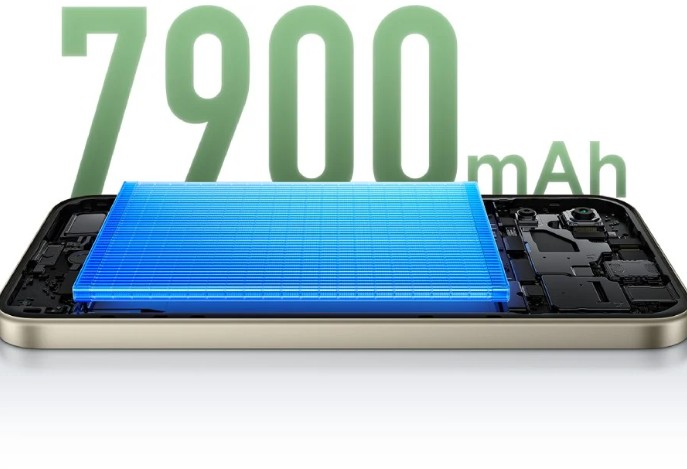
Battery life is easily the biggest talking point of the Redmi M100.
The phone packs a 7,900mAh battery, making it one of its strongest selling points in this price segment. The battery supports up to 45W wired charging and 22.5W wired reverse charging. The phone also supports the PPS charging protocol.
Reverse charging lets the M100 share power with compatible devices. For someone who spends long hours away from a charger, having a battery of this size could prove useful.
The numbers also show where Redmi has focused its priorities. Instead of spending the spec budget on an elaborate camera system, the company has focused more on endurance.
This approach makes practical sense. A large battery helps users who spend long periods watching videos, browsing the web, making calls, or using navigation without worrying about charging as often.
Of course, battery capacity alone does not guarantee a specific number of hours of use. Actual battery life depends on network conditions, brightness, apps, refresh rate, and user habits.
Snapdragon 4 Gen 5 Powers the Redmi M100
The Redmi M100 uses Qualcomm’s Snapdragon 4 Gen 5 mobile platform.
The chip uses a 4nm manufacturing process and an octa-core CPU. Redmi pairs the processor with up to 8GB of LPDDR4X RAM and up to 256GB of UFS 2.2 storage.
This hardware suggests a focus on everyday smartphone tasks rather than high-end gaming.
Users should expect the phone to handle common activities such as calls, messaging, social media, video streaming, browsing, and other routine apps. The Snapdragon 4 Gen 5 also gives the M100 5G support.
Redmi used the same chipset family in the Redmi 17 5G, which helps place the M100 in Xiaomi’s newer entry-level 5G lineup.
6.9-Inch 120Hz LCD Display
The Redmi M100 comes with a large 6.9-inch LCD screen.
The panel offers a 1,600 × 720 resolution and supports a refresh rate of up to 120Hz. Xiaomi also lists support for up to 240Hz touch sampling. The display reaches 675 nits typical brightness and up to 825 nits global brightness, according to Gadgets 360.
A 120Hz refresh rate should make scrolling and supported animations look smoother than a conventional 60Hz display.
The resolution is more modest. At 1,600 × 720 pixels, the screen sits firmly in the practical rather than premium category. On a display as large as 6.9 inches, users should not expect the same sharpness found on higher-resolution AMOLED panels.
Redmi also includes eye-protection features, with TÜV Rheinland certifications for low blue light and flicker-free performance, according to Gadgets 360. Corning Gorilla Glass protection is also reported for the display.
So the M100’s screen follows a simple formula: large size, smooth refresh rate, and basic eye-care features.
Redmi M100 Focuses on Elder Care Features
One of the more unusual parts of the Redmi M100 is its senior care mode.
The mode makes the interface easier to use by enlarging icons and fonts. Redmi also supports media and ringtone volume of up to 300% in this mode. An option to block unwanted calls adds another layer of convenience.
These features target a clear problem. Smartphones often pack dozens of menus, settings, and small interface elements into one screen. For some older users, the hardware itself is not the main challenge. Reading text, hearing notifications, or finding the right setting often causes more frustration.
Redmi’s approach is fairly direct. Make the controls larger, make audio louder, and reduce some common distractions.
There is even a little logic behind the M100’s otherwise unusual mix of specs. A massive battery, large display, loud audio options, and a simple interface make more sense for this audience than adding four rear cameras nobody asked for.
Redmi M100 Cameras
The M100’s camera setup is simple.
The phone features a 13-megapixel primary rear camera. Supported features include portrait mode, night mode, film filters, live photos, dual-view shooting, Pro mode, time-lapse photography, and document scanning.
For selfies and video calls, there is a 5-megapixel front camera.
The front camera supports features such as beauty mode, face recognition, portrait mode, and night mode.
The camera hardware looks modest compared with many modern smartphones. Redmi has clearly not positioned the M100 as a camera-first device.
That makes the phone easier to understand. The M100 focuses on battery life, usability, and basic smartphone features. Photography takes a back seat.
Design, Durability and Other Features
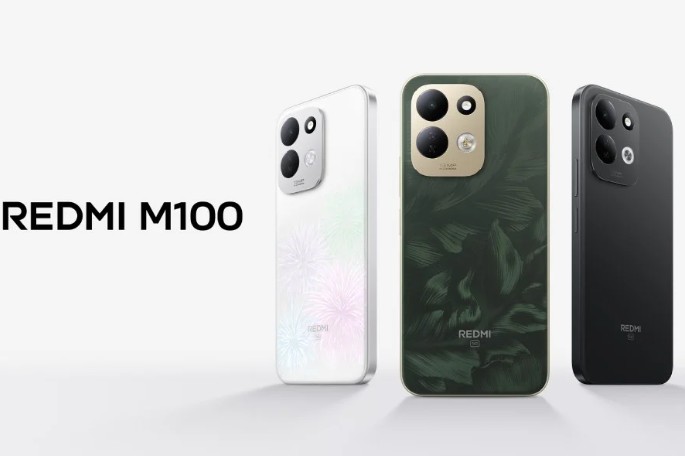
The Redmi M100 uses a four-dimensional micro-curved rear design, while the camera area gets RGB dynamic lighting. Redmi offers the phone in Midnight Black, Starry White, and Wilderness Green.
The handset measures 170.12 × 78.42 × 8.8mm and weighs 232 grams. That weight is unsurprising for a smartphone carrying a 7,900mAh battery.
The phone also includes dust and splash resistance. At the same time, the side fingerprint sensor has a rated endurance of up to 500,000 touches according to launch coverage.
NFC, 5G, Bluetooth 5.1, Wi-Fi 5, GPS, a USB Type-C port, and a 3.5mm headphone jack round out the hardware.
Redmi M100 Runs HyperOS 3
The Redmi M100 ships with Xiaomi HyperOS 3.
The software includes the senior care mode discussed above, along with the standard smartphone interface and features supported by HyperOS 3. Xiaomi’s own global website also identifies HyperOS 3 as its current operating system platform.
One important correction is worth making here. Some early reports described the software as “Surge OS 3,” but current coverage from Gadgets 360 and Notebookcheck identifies it as Xiaomi HyperOS 3.
Redmi M100 Price and Availability
The Redmi M100 has launched in China, where buyers can choose from three memory configurations.
The 8GB RAM + 128GB storage version costs CNY 1,799. The 6GB + 256GB model costs CNY 1,999, while the 8GB + 256GB version costs CNY 2,199.
Based on current published conversions, the starting price works out to roughly Rs 25,000 to Rs 25,500. Currency rates move daily, so the yuan price provides the more reliable reference point.
The phone is currently available in China in Midnight Black, Starry White, and Wilderness Green.
There is no confirmed Indian launch price in the sources reviewed for this article. Some reports have speculated about an India launch, but Redmi has not confirmed such pricing in the available launch information.
Redmi M100: What Makes It Different?
The Redmi M100 does not try to win the usual smartphone specification race.
Its 13MP rear camera looks modest. Its 720p-class resolution looks conservative on a 6.9-inch panel. Its Snapdragon 4 Gen 5 chipset targets entry-level performance.
But the M100 has a clear identity.
The 7,900mAh battery is large. The 45W charging support is useful. Reverse charging adds flexibility. The 6.9-inch display gives users plenty of screen space. The senior care mode addresses practical accessibility needs.
That combination makes the phone easier to understand than a specification sheet filled with features nobody needs.
Final Verdict
The Redmi M100 is an unusual addition to Redmi’s smartphone lineup, but the hardware follows a clear strategy.
It prioritizes battery life, basic performance, large-screen usability, and accessibility over camera hardware and premium display specs. The 7,900mAh battery is the headline feature, while the Snapdragon 4 Gen 5 and 120Hz display round out the core hardware package.
The senior care mode also gives the M100 a specific purpose. Larger text and icons, louder audio options, and unwanted-call blocking address everyday problems rather than chasing benchmark records.
For now, the Redmi M100 is officially a China-market launch. Redmi has not confirmed an India price or wider availability in the launch information reviewed here.
For readers looking for a phone built around endurance and straightforward use, the M100 is an interesting new Redmi option. And with a 7,900mAh battery, the charger might finally get a little more time off work.