
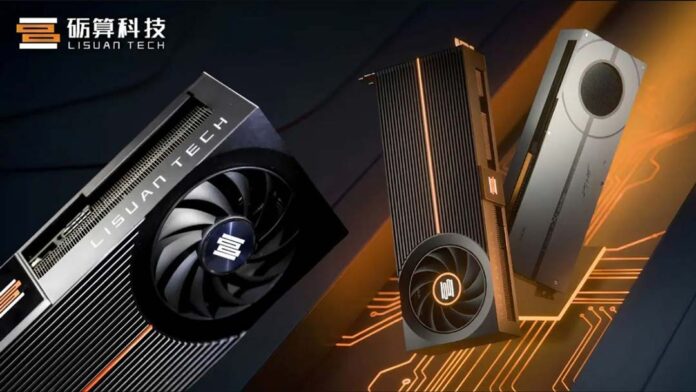
NVIDIA dominates the global GPU market. Most challengers fail before consumers even notice them. Yet China’s New Lisuan GPU achieved something few expected. The card sold out within hours, despite benchmark results showing clear losses compared to NVIDIA’s RTX 4060.
That outcome reveals a larger shift inside the gaming hardware industry. Buyers were not only purchasing frame rates; they were also purchasing frame rates. They were investing in China’s growing domestic semiconductor ecosystem.
Table of Contents
Why China’s New Lisuan GPU Generated Massive Demand
The Lisuan LX 7G100 received more than 30,000 pre-orders before launch day. The Lisuan GPU launched through JD.com with a retail price of around $480. Inventory disappeared almost immediately.
For a first-generation gaming Lisuan GPU from a relatively unknown Chinese startup, those numbers stand out.
Several factors fueled demand:
- Rising frustration with global GPU pricing
- Interest in Chinese-made alternatives to NVIDIA
- Curiosity around a new GPU architecture
- National support for domestic semiconductor products
- Limited launch inventory creates urgency
Performance alone did not drive the hype. Symbolism played a major role.
China’s New Lisuan GPU became one of the first serious attempts to build a domestic gaming graphics card ecosystem outside NVIDIA, AMD, and Intel.
What Powers the Lisuan LX 7G100?
The LX 7G100 includes 12GB VRAM and uses Lisuan’s proprietary “TrueGPU” architecture.
The company also achieved a milestone that few startups reach. The Lisuan GPU secured Microsoft WHQL certification. That certification improves driver trust and compatibility across Windows systems.
The GPU supports:
- DirectX 12
- Vulkan 1.3
- OpenGL 4.6
- OpenCL 3.0
- HDR output
- FreeSync
- 8K 60Hz display support
Those specifications position the GPU as a legitimate gaming product instead of a tech demonstration.
Still, two major features remain absent:
- Hardware ray tracing
- AI upscaling technology similar to DLSS or FSR
Those omissions limit competitiveness in modern AAA gaming.
How China’s New Lisuan GPU Performs Against RTX 4060
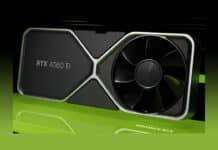
Lisuan originally promoted the GPU as a near-equivalent alternative to NVIDIA’s RTX 4060. Independent benchmarks told a different story.
Testing showed the LX 7G100 trailing the RTX 4060 by roughly 20% to 70%, depending on the game and optimization level.
Performance examples include:
- Black Myth: Wukong at 1080p delivered roughly 56 FPS
- Cyberpunk 2077 reached around 88 FPS
- Forza Horizon 5 showed major performance gaps
- Red Dead Redemption 2 exposed a weaker scaling performance
The RTX 4060 maintained stronger results across most workloads.
Industry reviewers also noted the GPU performed closer to the RTX 3060 in several benchmark scenarios.
The Counter-Intuitive Reason This GPU Still Won
Most consumers claim they buy GPUs based on raw performance per dollar. This launch exposed a different reality.
Early-stage hardware markets rarely succeed because of technical superiority. They succeed because buyers believe the platform will improve over time.
That pattern already happened in multiple industries:
- Chinese smartphones
- Electric vehicles
- consumer drones
- telecom equipment
Ten years ago, many consumers dismissed Chinese EV brands. Today, companies like BYD compete globally with established automakers.
The same long-term thinking is now evident in the GPU market.
Consumers who purchased China’s New Lisuan GPUs were effectively funding ecosystem growth.
That matters because GPU development depends heavily on:
- Driver optimization
- Software compatibility
- Developer relationships
- manufacturing scale
- AI acceleration frameworks
Those advantages compound over time.
Why NVIDIA Should Still Pay Attention
NVIDIA still controls roughly 92% of the discrete GPU and AI accelerator market. The company remains far ahead in software maturity, AI tooling, and gaming performance.
Yet the Lisuan launch highlights three warning signs.
Domestic GPU Demand Is Real
China continues to face semiconductor restrictions and export controls. Demand for locally developed alternatives will continue to grow.
Even weaker products receive strong market support when buyers prioritize ecosystem independence.
Software Gaps Shrink Faster Than Hardware Gaps
Hardware disadvantages often dominate headlines. Software optimization quietly closes performance gaps over several generations.
Intel’s Arc GPUs struggled heavily at launch. Driver improvements later boosted performance substantially across many titles.
Lisuan follows a similar path.
AI Changes GPU Competition
Traditional gaming performance no longer defines the full GPU market.
AI workloads, inference acceleration, and domestic cloud infrastructure create new demand segments where regional suppliers gain traction faster.
That opens opportunities for emerging GPU vendors.
Is China’s New Lisuan GPU Worth Buying?
For most global gamers, the answer remains difficult.
At roughly $480, competing options from NVIDIA and AMD still offer better value, more mature drivers, and advanced rendering features.
Gamers focused purely on performance-per-dollar will likely prefer:
- NVIDIA GeForce RTX 4060
- AMD Radeon RX 6600 XT
- Intel Arc B580
Still, evaluating the LX 7G100 only through FPS metrics misses the larger picture.
This launch marks China’s long-term push toward GPU independence amid heavy semiconductor pressure.
That strategic value explains why China’s New Lisuan GPU sold out despite weaker benchmark performance.
The Bigger Shift Behind the Launch
The GPU industry rarely changes overnight.
New competitors usually enter the low or mid-range segment first. Then the software improves. Manufacturing scales. Ecosystems mature.
Lisuan has already confirmed future GPU architectures with native ray tracing support.
If the company improves driver stability, AI acceleration, and power efficiency over the next few years, the competitive landscape shifts faster than many expect.
The first version does not need to beat NVIDIA.
The first version only needs to survive.
What do you think about China’s New Lisuan GPU? Would you buy an emerging GPU brand if its price matched that of established competitors? Share your thoughts in the comments.