

Hard to overlook: Google drops a fresh upgrade to top-tier models. Significant jumps are now being seen in logic, programming, and problem-solving across various formats. These skills? Needed for heavy-duty work, not just small talk. What changes exactly sits below: performance details emerge, edge over competitors surfaces through tests. Access points shift slightly – new spots open up. Real-world effects begin to show. Not flawless though – weaknesses remain visible. Insights here help make sense without overreaching.
Table of Contents
Google Gemini 3.1 Pro: Who made this model?
Google released Gemini 3.1 Pro as an incremental but meaningful step up from the Gemini 3 Pro series, focusing on deeper reasoning and better multimodal handling. Google published details and a preview that lists real usage paths for developers and enterprises.
What Google says about Gemini 3.1 Pro
Google positions this update as a refinement aimed at complex workflows. The model card and blog note improved token efficiency, stronger instruction following, and better performance on long, multi-stage tasks. Access is rolling out across consumer and developer surfaces, signaling that Google intends to deploy this model in production, not just for research demos.
Google Gemini 3.1 Pro Benchmark performance, explained
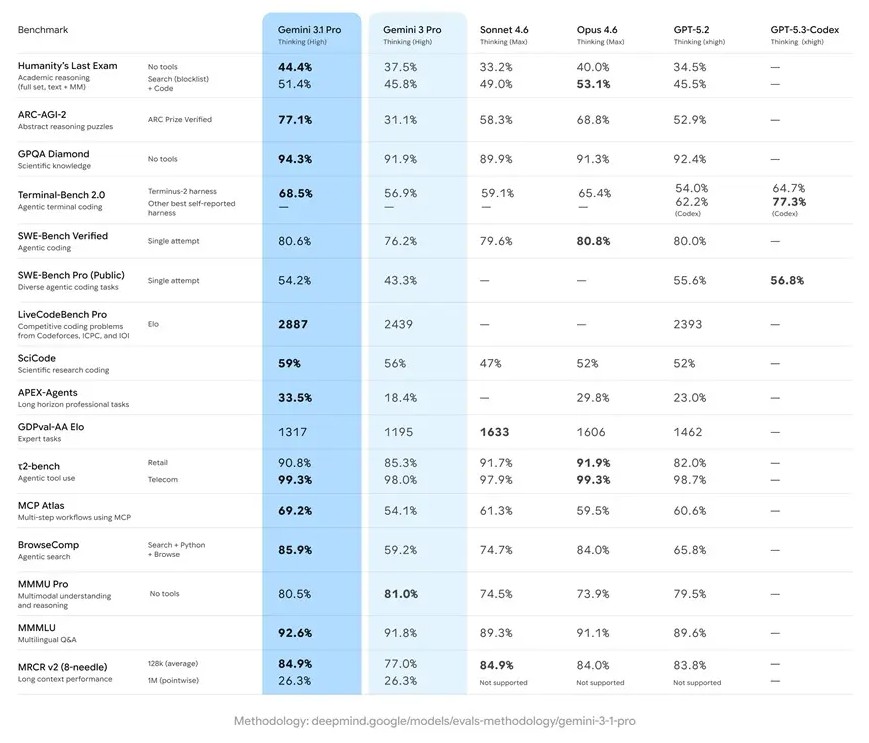
Google published benchmark results showing that 3.1 Pro led on most tests. These numbers offer a clearer, measurable way to compare models than marketing alone. Below are the most notable results, with what they mean.
Humanity’s Last Exam, no tools
Gemini 3.1 Pro scored 44.4% on this difficult reasoning test without external tools. That is a solid lead on the same test in base configurations, showing stronger raw reasoning when the model must rely on its internal knowledge.
Humanity’s Last Exam, with tools
When allowed to use tools like search or coding aides, the score rose to 51.4%. That shows the model integrates tools effectively, although some rivals slightly outperformed it in the tool-enabled configuration. It points to real-world usefulness where models rely on external sources.
ARC-AGI-2, abstract reasoning
On ARC-AGI-2, a demanding abstract reasoning benchmark, Gemini 3.1 Pro posted 77.1%. That is a large jump compared to older Gemini versions, and it outscored several leading competitor builds in published comparisons. High results here suggest better planning and multi-step problem solving.
GPQA Diamond and scientific literacy
Gemini 3.1 Pro reached 94.3% on GPQA Diamond, a test of advanced scientific knowledge. That kind of performance matters for research assistance, technical summarization, and domains that require precise domain knowledge.
Coding and agentic evaluation
On coding and agent-style tasks, Gemini 3.1 Pro also did well. Examples include an 80.6% score on SWE-Bench Verified and a strong Elo score on LiveCodeBench Pro. In practice, this suggests that the model is better at writing, testing, and reasoning about code when integrated into workflows.
Multimodal gains and visual reasoning
Gemini 3.1 Pro is natively multimodal, meaning it reads and reasons across text, images, audio, and structured data. Google demonstrated improvements in SVG and vector output quality, with more precise alignment and smoother motion sequences in generated visuals. For creators and designers, this reduces the manual cleanup required after generation.
Where can you use it today?
Google is rolling the model into the Gemini app, NotebookLM, Google AI Studio, Antigravity, and Vertex AI. That mix covers consumer-facing tools, research notebooks, developer APIs, and agent-first coding environments, which makes the model quickly usable for prototyping and production tasks.
How it stacks up to competitors
Anthropic and OpenAI remain strong rivals, with some benchmarks and configurations where they still lead. For example, certain tool-enabled evaluations saw rival models edge ahead. The broader picture is a rapid cycle of small, meaningful gains from each vendor, so a single leadership claim is a snapshot rather than a permanent status.
Real-world implications for developers and businesses
- Faster prototyping, especially for multimodal apps. Teams can iterate visually and textually within the same flow, speeding design-to-deployment.
- Better agentic automation. If your workflow requires agents that operate across terminals, browsers, and IDEs, Gemini 3.1 Pro’s gains in multi-step execution reduce the cost of supervision.
- Improved scientific and technical assistance. Strong performance on domain tests means fewer hallucinations in areas that need accuracy, although verification remains essential.
Practical examples and use cases
Example 1, product design
A product team can feed sketches, user stories, and test logs into the model and receive a prioritised list of design fixes and updated SVG assets. That saves time on both UI iteration and documentation.
Example 2, coding assistant
In an agent environment, the model can triage failing tests, propose code fixes, run unit checks via integrated tools, and report back with artifacts. It moves it closer to junior-level engineering support, while still requiring human oversight.
Example 3, research summarization
Researchers can submit papers, charts, and raw data. The model can synthesize a draft summary and highlight likely gaps, helping accelerate literature reviews without replacing expert validation.
Important limitations and caveats
- Benchmarks are useful, but they are not reality itself. Benchmark tests narrow tasks under controlled assumptions, while real-world systems involve messy inputs and changing requirements.
- Tool-enabled comparisons vary a lot by configuration. Scores that use external search or coding aides depend on how those tools are integrated and curated.
- Model updates can change behavior quickly. A 0.1 release number reflects iterative improvements, but this also means you should expect ongoing change management when you adopt the model.
Safety, governance, and responsible use
Google’s model card includes safety evaluations and notes on capability thresholds. The company reports that the model did not cross critical capability thresholds in sensitive areas. Still, improved capability underscores the importance of stronger guardrails and human review processes. For enterprises, this means integrating monitoring, access controls, and human-in-the-loop checks from day one.
What to watch next
- Real-world benchmarks from independent labs, not just vendor-supplied charts. These will show how the model behaves under diverse conditions.
- Tool and chain-of-thought interplay, since tool-enabled performance is where small engineering differences can change outcomes.
- Pricing and rate limits for Vertex AI and Gemini API access, which will determine how cost-effective the model is for large-scale use.
Practical takeaways
- If you are building multimodal products, test Gemini 3.1 Pro in a narrow pilot, focusing on integration with your tools.
- Use benchmark strengths to pick candidate use cases, but validate with domain-specific tests before full rollout.
- Maintain human oversight for high-risk domains, including legal, medical, and safety-critical systems.
- Monitor costs and latency when moving from prototype to production, especially for long context windows.
Conclusion
Gemini 3.1 Pro is a meaningful technical update, with stronger reasoning, improved multimodal outputs, and better agentic performance. The benchmark wins are real, and they matter for teams that need more than simple text completions. At the same time, benchmarks do not end the debate, and rivals remain competitive in specific areas. For most teams, the right move is a measured pilot, clear verification steps, and an eye on independent evaluations as the model is used in production. The release raises the bar, which is good for developers and users who need systems that handle real complexity.