

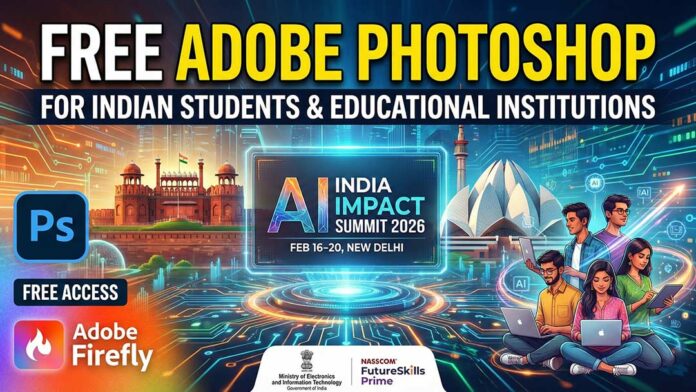
Out of nowhere, Adobe stepped up at the India AI Impact Summit 2026, offering students in recognised colleges across the country no-cost entry to essential creative software. While such access might shift the way young minds explore design and narrative through artificial intelligence, reactions were mixed. Behind the scenes, details remain fuzzy – exactly who qualifies, how support will roll out, or whether skills training follows. Though bold on paper, the real test lies beyond the stage lights.
Table of Contents
Adobe’s announcements at the summit
Starting today, college learners across India can use top Adobe tools at no cost. Free entry includes Photoshop, Acrobat, and Adobe Firefly for those enrolled in recognised institutions. Learning resources come along, tied to real skill checks. Instead of just software, they get guidance and proof of progress. This move targets sharper digital abilities. Future creators may find their path clearer with hands-on experience. Schools become launchpads when tech meets training. Access like this could shift how students build portfolios. Credentials earned here travel beyond classrooms. One goal stands out: preparing young minds for jobs that demand imagination and precision.
What comes in the set
Photoshop and its uses
A blank canvas meets endless tweaks when creativity needs room to grow. Picture adjustments find their home here alongside digital sketches meant for screens. Work comes together where details matter most. Folks learning design often land on this tool for school projects and personal samples alike.
Acrobat for documents and collaboration
With Acrobat, schoolwork turns into tidy PDFs. Marking up sources? That happens smoothly, too. Sharing files keeps fonts and layout locked. Team projects stay neat that way.
Firefly and Artificial Intelligence Spark New Creative Paths
Flying out of beta, Firefly stands as Adobe’s own generative AI system. It builds visuals, shapes text treatments, crafts design pieces – all powered by artificial intelligence. According to Adobe, future updates will tightly integrate it with additional models. Safety in commercial use guides its development path.
Access depends on eligibility, while the program’s scope varies based on available resources.
Starting now, Adobe is focusing on learners within approved universities and colleges. Schools across the country will see new creative spaces pop up – thousands getting labs built right into classrooms. Hundreds of college campuses are included as well. Learning paths will shift thanks to ready-made lessons handed over by the company. Knowledge building matters so that workshops will roll out alongside official credentials valued in the job market. Earning proof of skill becomes easier through these steps.
Why this matters for students
Getting high-end software lifts a heavy cost barrier. Students – particularly in fields like design, film, media, or animation – once had to pay for short trials or steep subscription fees. With no price tag, now comes stronger portfolios, deeper project experience, and yet sharper preparation for careers.
Adobe supports learning initiatives.
Something different happens when you mix tools with learning – Adobe does that. Learning how things work becomes easier when practice is paired with real tasks. Skills get proven, not just claimed, so jobs see what someone can actually do. Working with programs creates space for new kinds of lessons to appear. Teaching about artificial intelligence grows stronger because resources arrive where they are needed.
Partnerships and government alignment
Now shaping up across India, Adobe teams up with local groups such as NASSCOM’s FutureSkills Prime to roll out training and certifications in artificial intelligence. Backed by national priorities, the effort fits within wider efforts to grow skilled workforces in animation, gaming, VFX, and comic arts. Because of that fit, the project links smoothly into current learning routes and job pipelines.
Stories from actual practice plus initial applications
A movie-making learner today tweaks animated promos, sketches ideas in Photoshop and Firefly, and then pulls together shooting paperwork in Acrobat. One studying design puts together real-world samples, ready for clients, all without monthly charges stacking up. Better internship opportunities arise from this, along with stronger school assignments taking shape.
Comparison with the Airtel Adobe deal
Back at the start of the year, Airtel teamed up with Adobe so users could get a full year of Adobe Express Premium for free. That move was really about helping people make quick social media graphics and brief clips. Meanwhile, Adobe’s education plan goes further, delivering Photoshop, Acrobat, and Firefly via schools and colleges.
Benefits for the AVGC sector and job markets
Fees out of the way might push more learners into animation, visual effects, gaming, comics – fields bundled as AVGC. When classrooms fill, studios and new companies could draw from a wider pool of skilled people, fueling faster expansion and hiring surges.
Concerns and limitations to watch
Equity and reach
Not every school fits into the program – some leave out trade colleges, along with learners from remote areas. Who gets in often ties to how each campus rolls things out. Lab availability can shape who actually benefits, depending on where the equipment lands.
Training quality and assessment
What you get for free often lacks proper guidance. Learning happens best when there is a clear path, experienced people leading the way, and tasks that feel like actual work. Worth comes from structure, support, plus experiences shaped by reality.
Data IP and Commercial Use
To start, learners should understand the rules around ownership when working with AI-generated material. Instead of assuming safety, schools should explain what can be sold or shared. While Adobe promotes Firefly as low-risk for business use, awareness still matters. Without proper direction, misuse creeps in. Clarity comes not from tools alone, but through education built into learning spaces.
Balanced viewpoints and possible downsides
One way to save money here is by opening doors wider – good news for many. Still, leaning too hard on just one company can backfire. Schools might balance Adobe programs with lessons in how to think through problems, act responsibly, plus work across platforms. When learners grasp ideas that go beyond any single tool, they stay ready for change.
Practical steps for students
- Start by checking with your school’s office – find out if they’re involved, then ask about signing up.
- Browse through the training modules Adobe supplies. Then think about going for their certification options instead.
- A single project can speak volumes when it reveals how you think. Start from the middle, show sketches that stumble forward. Include notes where ideas shifted direction suddenly. Let rough drafts sit beside cleaner versions without apology. Walk through decisions using simple words, no jargon. Reveal dead ends like landmarks. Focus on movement, not perfection. Finish by leaving some threads loose – real work rarely ties up neatly.
- Finding ways to share files means knowing how to package them for others. Working together gets smoother when changes are tracked step by step.
Practical steps for educators and institutions
- Start your application using Adobe’s school-based system.
- Integrate Adobe certifications into course assessments.
- Ensure labs have the hardware and internet capacity required for Creative Cloud apps.
- Teach data and IP literacy alongside tool training.
From here on out, things will shift in this direction.
A single change might improve job prospects and imagination for countless learners. Should cities move faster than villages, divides in opportunity may grow. Success hinges on teamwork, the tools available, and the speed with which teachers embrace real-world learning paths.
Final takeaway
When Adobe spoke at the India AI Impact Summit 2026, it revealed something real for learners – tools once too expensive are now within reach. Because these resources exist, schools must explain how to get them and help students join workshops or earn credentials. Teachers hold a quiet power here: without strong lessons and honest direction, access alone won’t shift anything. What happens next depends on pairing opportunity with care – and that balance might reshape how creativity fuels progress across the country.