
MediaTek has officially launched the Dimensity 9600 Pro, its new flagship smartphone processor and the company’s first 2nm mobile SoC. Announced on September 15, 2026, the chip combines a new Arm CPU design, faster memory and storage standards, a dual-NPU AI system, upgraded graphics, and a new imaging platform.
The headline figure is the move to a 2nm process, but the smaller manufacturing node is only part of the story. MediaTek has also redesigned the CPU and tightly integrated it with its AI hardware. The result is a chip aimed at phones that need to handle demanding gaming, local AI, photography, video, and everyday multitasking without wasting as much power.
And yes, the numbers are getting a little silly. A phone processor now has a clock speed that sounds more suited to a desktop battle than a device sitting in your pocket.
Table of Contents
MediaTek Dimensity 9600 Pro: What’s New?
The Dimensity 9600 Pro uses a 2+3+3 all-big-core CPU configuration. It includes two Arm C2-Ultra cores running at up to 4.55GHz, three C2-Pro cores at up to 4.35GHz, and another three C2-Pro cores clocked at up to 3.1GHz. MediaTek says this design increases single-core performance by up to 17% and multi-core performance by up to 15% compared with the previous generation.
The key point is that MediaTek has continued with an all-big-core approach rather than adding traditional efficiency cores. The company is betting that smarter scheduling and the improved manufacturing process can deliver the performance needed for demanding workloads while keeping power use under control.
MediaTek says the Dimensity 9600 Pro cuts multi-core power consumption by up to 61% compared with the previous generation at the same peak performance level. It also reports a 37% power reduction for single-core performance. These figures come from MediaTek’s internal testing, so treat them as manufacturer claims rather than independent benchmark results.
The 2nm Process Is the Big Story
The switch to 2nm marks a major technical change for the Dimensity 9600 Pro compared with earlier Dimensity flagship chips.
MediaTek says it developed the processor using a combination of TSMC’s advanced 2nm process and design-technology co-optimization. In simple terms, the company did more than shrink the manufacturing process. It also adjusted the chip design to take advantage of the new manufacturing technology.
For smartphone owners, efficiency matters as much as peak speed. A processor that wins a benchmark and drains the battery quickly is not particularly helpful when you’re standing outside looking for a charger.
That is why MediaTek’s power figures deserve attention. The company is targeting sustained workloads where phones spend a lot of time processing data, running applications, and handling AI tasks rather than simply chasing short bursts of speed.
(Also See: Snapdragon 8 Elite vs Dimensity 9400: How MediaTek Outperforms Qualcomm in One Way)
CPU Performance Gets a Noticeable Upgrade
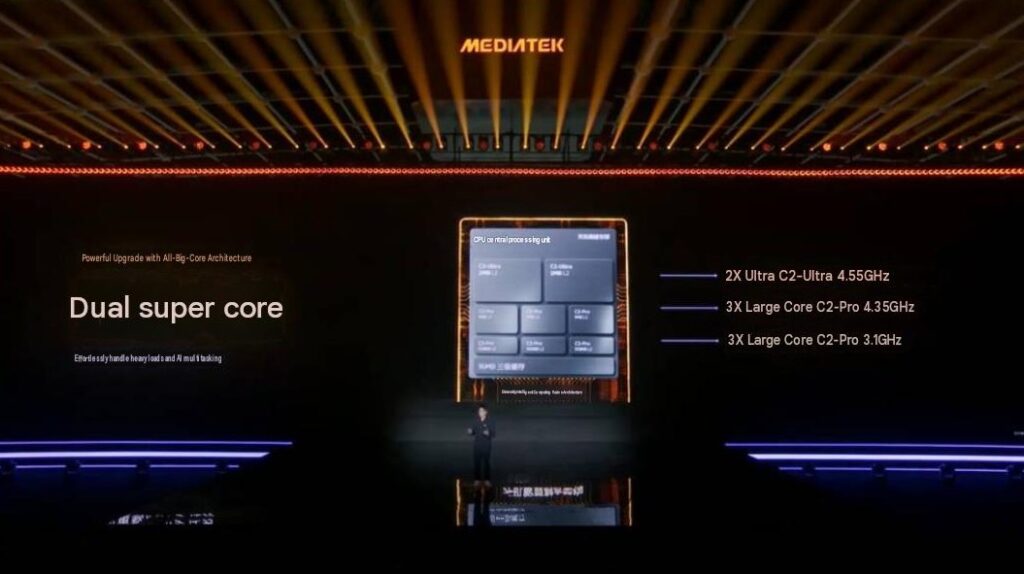
The Dimensity 9600 Pro’s CPU is built around Arm’s new C2 CPU platform. Arm describes the C2-Ultra as its flagship mobile CPU core, designed for high single-thread performance and quick responses. Meanwhile, C2-Pro focuses more on sustained workloads and efficiency.
MediaTek’s 2+3+3 configuration uses both approaches. The two C2-Ultra cores handle demanding foreground tasks, while the six C2-Pro cores provide additional processing capacity for heavier workloads.
According to MediaTek, the chip reaches up to 17% higher single-core performance and 15% higher multi-core performance than the previous generation. The company also says its Dimensity Scheduling Engine has been upgraded to coordinate computing, memory, and power resources more intelligently.
One important correction is worth making here: published numbers such as 4,276 single-core and 12,650 multi-core Geekbench scores should not be presented as official MediaTek benchmark figures. MediaTek’s launch announcement does not list those Geekbench 6.4 results. Independent pre-launch reports have published different Geekbench results from unreleased devices, which shows why benchmark numbers can change depending on the phone, software, cooling, and test version.
Faster LPDDR6 Memory and UFS 5.0 Storage
The processor itself is only one part of a modern smartphone. Data needs to move quickly between the CPU, AI hardware, memory, and storage.
The Dimensity 9600 Pro supports LPDDR6 memory and UFS 5.0 storage. MediaTek says this is the first time these standards appear in its platform, alongside a 34.5MB cache across the chip’s cache hierarchy.
This matters when a phone is juggling several demanding tasks. Faster memory can help supply data to the CPU and GPU. In contrast, faster storage can reduce bottlenecks during application loading and large file operations.
MediaTek also uses its AI Computing Fusion Architecture to connect CPU and NPU resources more closely. The company aims to avoid treating AI as an isolated function and instead share compute resources based on what a workload actually needs.
AI Gets Its Own Major Upgrade
AI is one of the main reasons MediaTek has redesigned the Dimensity 9600 Pro.
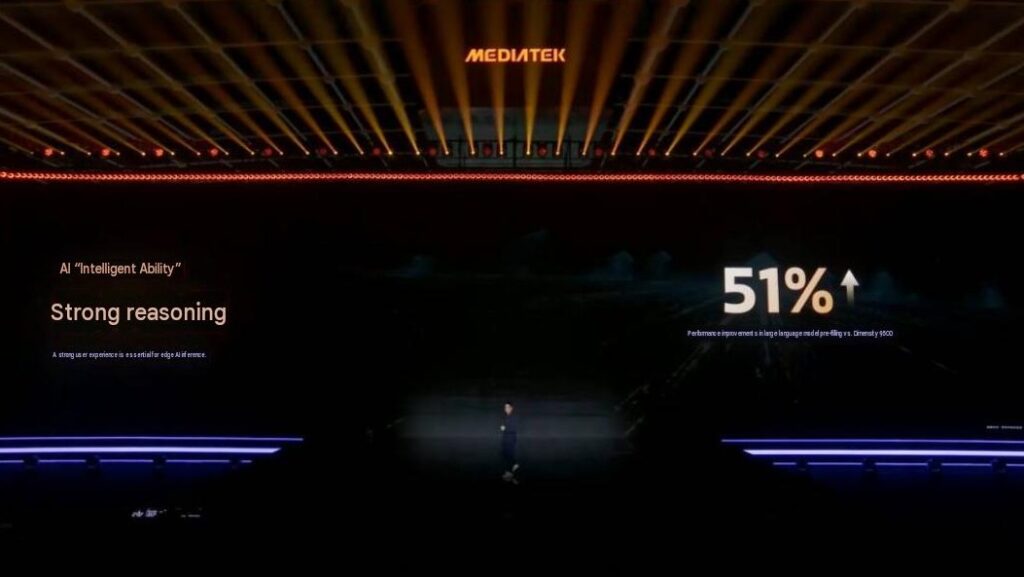
The chip uses a dual-NPU architecture built around the MediaTek NPU 1090 and a second-generation Super Efficient NPU. MediaTek says the NPU 1090 delivers up to 51% higher LLM prefill performance and up to 55% higher token-generation performance per watt. It can also support on-device models with up to 30 billion parameters.
The second NPU takes a different approach. It focuses on AI workloads that remain active in the background. MediaTek says it can reduce power consumption for always-on AI by up to 40%.
That could matter for features such as background perception, personalized assistance, and other AI functions that do not need the full performance of the main processor every second.
MediaTek is also promoting the platform for agentic AI, where the phone can perform multiple steps rather than simply answering a single prompt. The company says the Dimensity 9600 Pro is designed to coordinate CPU, GPU, NPU, memory, and software resources for these workloads.
Gaming Performance Gets a Big Lift
Gaming is another major focus.
The Dimensity 9600 Pro integrates the Arm Mali-G2-Ultra NX GPU. MediaTek claims up to 27% higher peak graphics performance, 24% lower power consumption at peak performance, and 18% faster ray tracing than the previous generation.
The chip also introduces MediaTek’s Neural Graphics Architecture, which combines GPU processing with AI computing. MediaTek HyperEngine works alongside the graphics hardware to manage gameplay and improve the overall gaming experience.
MediaTek says supported workloads can reach up to 185 frames per second. That does not mean every game will run at 185fps. The actual frame rate depends on the game, resolution, display refresh rate, thermal limits, and the phone manufacturer’s tuning.
Still, the combination of faster graphics and lower power use could help flagship phones maintain high performance longer.
Imagiq 1290 Targets Photography and Video
Camera processing gets a substantial update with the Imagiq 1290 ISP and MediaTek’s new AI Imaging Fusion Architecture.
The platform supports 4K recording at 240fps for native ultra-slow-motion video, along with 4K 120fps cinematic Log recording, 4K60 AI True Color Tone, and imaging with up to 17 stops of dynamic range, according to MediaTek.
MediaTek is also adding NPU-powered 60fps motion capture. That gives phone makers more tools for computational photography and video processing without relying entirely on the CPU.
These features will not automatically turn every flagship phone into a professional camera. The final image still depends heavily on the camera sensor, lenses, stabilization, software processing, and the manufacturer’s tuning.
The processor gives manufacturers more room to build those features.
Which Phones Will Use the Dimensity 9600 Pro?
MediaTek says the first smartphones powered by the Dimensity 9600 Pro are expected to launch during the fourth quarter of 2026. The company did not officially name specific phone models in its launch announcement.
However, pre-launch reports have linked the chip to upcoming flagship phones from Vivo and Oppo. Vivo’s X500 Pro series has been associated with the new 2nm Dimensity platform. At the same time, reports have also pointed to the Oppo Find X10 series. Treat these reports as product information and leaks, not an official MediaTek device announcement.
That distinction matters. Smartphone specifications can change before launch, and chipset assignments can differ by region or model.
Dimensity 9600 Pro vs Dimensity 9500
On paper, the Dimensity 9600 Pro improves the areas that matter most in a modern flagship phone.
CPU performance rises by up to 17% for single-core workloads and 15% for multi-core workloads. MediaTek also claims substantial reductions in power consumption. The GPU gets a 27% peak performance increase, ray tracing improves by 18%, and peak GPU power consumption drops by 24%.
AI performance also moves forward, with faster LLM processing, better efficiency per token, and support for larger on-device models.
The bigger change may come from the platform around the CPU. LPDDR6, UFS 5.0, the 34.5MB cache, dual-NPU architecture, and AI-focused scheduling all work together rather than acting as separate upgrades.
Should You Be Excited About the Dimensity 9600 Pro?
The MediaTek Dimensity 9600 Pro looks like a serious step forward for flagship Android smartphones, especially because MediaTek is attacking performance and power efficiency at the same time.
Its 2nm manufacturing process gives the company a new foundation. The Arm C2 CPU design raises processing performance, while the Mali-G2-Ultra NX targets faster gaming and ray tracing. The NPU 1090 pushes more AI processing directly onto the phone, and LPDDR6 and UFS 5.0 prepare the platform for faster data movement.
The key caveat is that most performance figures available right now come from MediaTek’s own laboratory testing. Real-world results will depend on the smartphone, cooling system, software, battery capacity, and manufacturer’s tuning. MediaTek explicitly notes that it achieved these performance metrics on demo devices in its labs.
So, no, your current phone probably won’t slow down overnight. But the Dimensity 9600 Pro gives manufacturers a much more powerful platform for the next generation of flagship devices.
And the most interesting part may not be the 4.55GHz headline figure. It may be how much of that performance a phone can actually use without turning its battery into a portable hand warmer.
Source:- MediaTek Press Room