

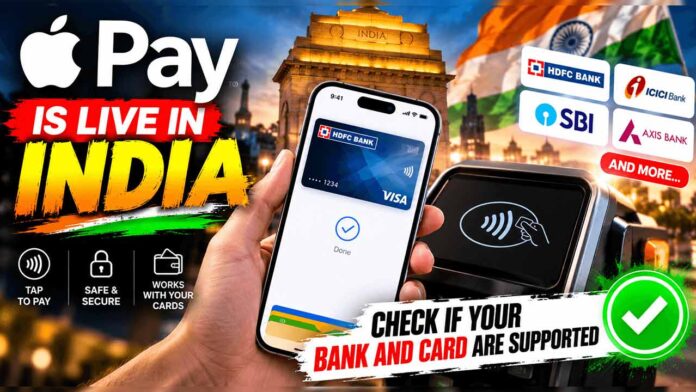
Apple Pay has officially launched in India on September 30, 2026, ending years of waiting for Apple’s contactless payment service to arrive in the country.
The launch gives iPhone, iPad and Apple Watch users a new way to pay in stores, apps and on supported websites. There is one big catch, though. Apple Pay starts with a limited set of cards.
At launch, customers with eligible Axis Bank-issued Visa and Mastercard credit cards can add their cards to Apple Pay. Cards from other major banks and India’s RuPay network are not part of the initial rollout. Apple also says Mac support is coming soon.
So, before you open Apple Wallet and start tapping your phone at every payment machine in sight, check whether your bank and card actually qualify.
Table of Contents
Which Banks Support Apple Pay in India?
Right now, Axis Bank is Apple’s first banking partner in India.
The launch supports eligible Axis Bank credit cards running on the Visa and Mastercard networks. Apple has not announced broad support for other Indian banks in the initial rollout. Reuters reported that Apple has held discussions with HDFC Bank and ICICI Bank, but those banks were not part of the launch.
That means an iPhone alone isn’t enough.
You also need an eligible card from the supported issuer. If you use an HDFC Bank, ICICI Bank, SBI Card or another bank card today, Apple Pay may not let you add it until that issuer joins the service.
The same rule applies to the card network. An Axis Bank customer still needs an eligible Visa or Mastercard credit card for the launch version of Apple Pay.
Which Cards Work With Apple Pay in India?
At launch, Apple specifically lists Axis Bank-issued Visa and Mastercard credit cards.
Apple’s announcement does not list RuPay cards as supported. Reuters also confirmed that cards on India’s domestic RuPay network are not eligible for Apple Pay at launch.
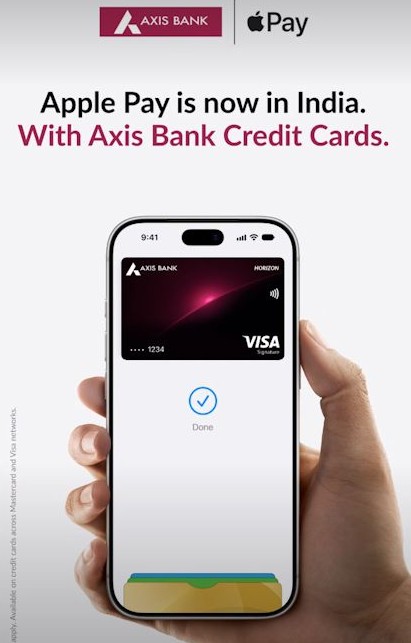
The easiest way to check your own card is to try adding it through Apple Wallet or the latest Axis Bank app. Apple says eligible customers can add the card through either method, after which the card is ready for use once the setup process is completed.
This is important because a bank can issue cards on more than one payment network. Seeing the Axis Bank name on your card doesn’t tell you everything. The Visa or Mastercard branding also matters for this first phase.
Does Apple Pay Support UPI in India?
No. UPI is not part of the Apple Pay launch.
That is one of the biggest differences between Apple Pay and the payment methods many Indians already use every day. Apple Pay is built around eligible payment cards, while UPI connects bank accounts through India’s instant payment system.
This limitation matters because UPI remains much larger by transaction volume.
According to NPCI data, UPI processed 24,508.96 million transactions in August 2026, worth ₹29,82,355.95 crore. That’s roughly 24.51 billion transactions in a single month.
RBI data cited by Hindustan Times shows that credit cards recorded 632.45 million payment transactions worth about ₹2.02 lakh crore during the same month. That puts UPI transaction volume far above credit card payments in India.
Apple Pay therefore enters a market where QR-based UPI payments are already deeply established. For Apple users, the service works as a card payment option rather than a replacement for UPI.
Apple has not announced a confirmed date for UPI support in Apple Pay India.
Does Apple Pay Support RuPay Cards?
RuPay cards are also not supported at launch.
RuPay is India’s domestic card network and is widely used for credit and debit cards. However, Apple’s initial Indian rollout is based on Visa and Mastercard credit cards issued by Axis Bank.
So, an Axis Bank RuPay card will not qualify simply because a supported bank issues it.
For now, the combination to remember is simple: Axis Bank plus an eligible Visa or Mastercard credit card.
Which iPhones and Apple Watches Support Apple Pay?
Apple says the India launch requires an iPhone XR or later running iOS 18 or later.
Apple Watch support starts with Apple Watch Series 6 or later running watchOS 11 or later. The Apple Watch must also be paired with a compatible iPhone.
Apple Pay is available across iPhone, iPad and Apple Watch in India. Mac support is coming soon.
On iPhone and Apple Watch, users can make contactless payments at supported terminals. iPhone and iPad users can also use Apple Pay for supported purchases inside apps and on websites.
That makes the service useful beyond physical stores. You can use the same card stored in Apple Wallet for supported online checkouts without repeatedly typing your card information.
How to Set Up Apple Pay in India
Setting up Apple Pay is fairly simple when you have an eligible Axis Bank card.
You can start from the latest Axis Bank app or directly from Apple Wallet.
To use Wallet, open the app on your iPhone and tap the plus button. Follow the instructions to add your eligible credit card. Your card will then go through the bank’s verification process.
Once the card has been added successfully, Apple says you can start using Apple Pay.
You will also need a compatible Apple device with the required software, an Apple Account signed in on the device and Face ID, Touch ID or a device passcode.
If the card refuses to appear or setup fails, that doesn’t necessarily mean Apple Pay is broken. The card itself may not be eligible, or the issuer may require additional verification.
How to Pay With Apple Pay at Stores
Once your card is ready, paying at a compatible contactless terminal is quick.
On an iPhone with Face ID, double-click the side button and authenticate with Face ID or your passcode when prompted. Then hold the top of the iPhone near the contactless reader.
For an iPhone with a Home button, the payment process uses the Home button instead.
On Apple Watch, double-click the side button and hold the display near the contactless reader.
Apple says customers can use Apple Pay at thousands of in-store and online merchants across India, as well as wherever compatible NFC transactions are accepted.
The phone basically replaces the card at the payment terminal. You do not need to pull a physical card from your Wallet and hand it over at checkout.
And yes, your card’s existing rewards and benefits continue to apply when you use the eligible card through Apple Pay, according to Apple.
Where Can You Use Apple Pay in India?
Apple says Apple Pay will be accepted by millions of merchants across India at launch.
The company has named Apple Store locations, Blinkit, Chaayos, Comet, Croma, Interflora, Ixigo, Le15 Patisserie, Reliance brands, Tata 1mg and Zomato among the participating merchants.
Apple has also worked with payment service providers including BillDesk, Cashfree, Juspay, Mswipe, Paytm, PayU, Pine Labs and Razorpay to connect the service with merchant networks.
Still, users should not assume that every contactless terminal will accept every Apple Pay transaction. Acceptance depends on the merchant and payment setup.
That is especially worth remembering during the early days of the rollout. A terminal may support NFC payments, but a particular merchant’s payment flow may not yet support Apple Pay.
How Does Apple Pay Protect Your Card Details?
Apple Pay does not simply copy your physical card into your phone.
When you add an eligible card, Apple says it doesn’t store the actual card number on the device or on Apple’s servers. Instead, Apple creates a unique Device Account Number, encrypts it, and stores it in the device’s Secure Element.
During a payment, the Device Account Number and a transaction-specific security code are used instead of sending the full card number to the merchant.
Apple’s security documentation says neither Apple nor the user’s device shares the full card number with merchants during payment. Authentication is completed before payment information is sent.
Apple also says users can use Find My to locate, lock or suspend payments from a lost or stolen iPhone.
These protections are part of Apple’s existing Apple Pay architecture. They don’t mean card fraud becomes impossible, so normal account and device security still matter.
Why Did Apple Pay Take So Long to Reach India?
Apple Pay first launched in the United States in 2014. India arrived more than a decade later.
Apple’s Jennifer Bailey said the company needed the right regulatory framework, payment infrastructure and banking and network partners before launching in the market. She also pointed to the Reserve Bank of India’s support for biometric authentication for card payments as an important development.
That change matters because Apple Pay relies heavily on device-based authentication such as Face ID and Touch ID.
Apple also needed a banking partner and card networks that could support the system. The initial combination is now in place with Axis Bank, Visa and Mastercard.
The result is a launch that starts with one bank and two card networks instead of trying to support the entire Indian card market on day one.
Apple Pay India Starts Small, but the Service Is Now Official
Apple Pay is finally live in India, but the first phase is much narrower than many users may have expected.
For now, the key requirements are an eligible Axis Bank Visa or Mastercard credit card, a compatible Apple device and a supported merchant or payment terminal.
UPI and RuPay are not supported at launch, while major banks such as HDFC Bank, ICICI Bank and SBI Card are outside the initial lineup. Apple’s Indian rollout can therefore be best understood as the beginning of its card-based payment service in the country, rather than a complete replacement for existing payment options.
Apple says Apple Pay is now available in more than 90 countries and regions and works with more than 11,000 bank and network partners worldwide. India is now part of that wider network, even though its local rollout begins with a much smaller group of supported cards.
For Axis Bank customers with an eligible Visa or Mastercard credit card, though, the wait is over. You can now add your card to Apple Wallet and use Apple Pay in India.